
No will in WA: how intestacy rules divide your estate
Most people assume that when they die, their assets will find their way to the right people. Their partner will get the house, their kids will share what's left, and everything will be sorted without too much fuss. That assumption is wrong without a valid will. When someone dies with no will in WA, the state applies its own rigid distribution formula, and the result is often far removed from what that person would have chosen. Solicitors who work regularly in estate administration, including those serving regional and coastal WA communities, see the fallout from this more often than most families expect.
This article walks through exactly how WA intestacy rules operate: who inherits, in what order, what the current dollar thresholds are, which assets fall outside those rules entirely, and what your family must do to administer the estate. If you're wondering whether you need a will, the answer is almost certainly yes, and by the end of this article, you'll understand precisely why.
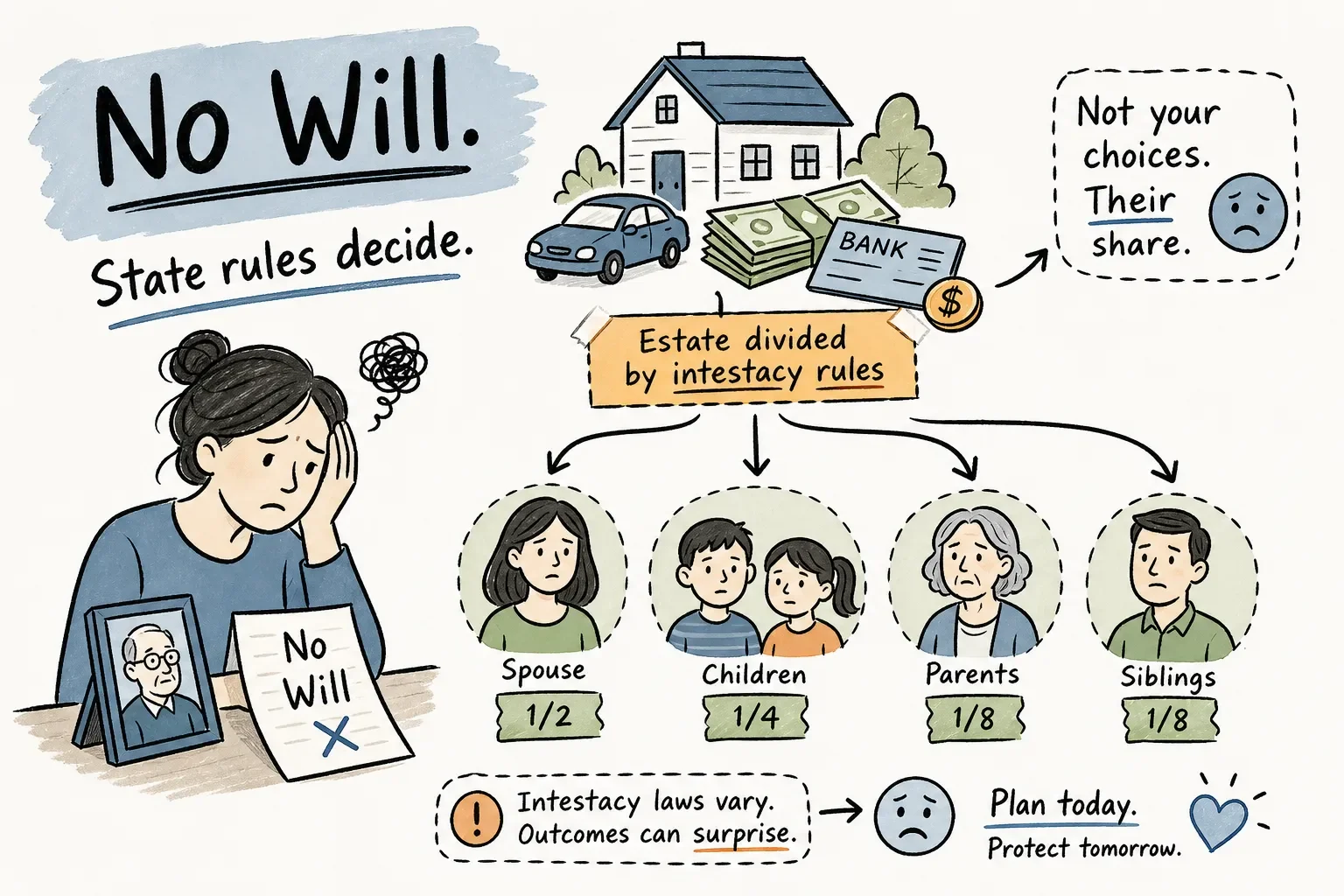
What WA intestacy rules actually mean
"Intestacy" simply means dying without a valid will. When this happens in Western Australia, section 14 of the Administration Act 1903 (WA) takes over and applies a fixed formula based entirely on surviving family relationships. The law does not consider what the deceased might have wanted, any verbal promises made to family members, or long-standing arrangements about who should receive what. It applies the same hierarchy to every intestate estate, regardless of the family's circumstances.
A will can be invalid rather than simply absent. A will witnessed incorrectly, or one made before a marriage that was never updated, may be legally ineffective. Under WA legislation, marriage may revoke an earlier will in certain circumstances, seek legal advice or refer to the relevant WA statutes to confirm how this affects your situation. This means someone can genuinely believe they have a valid will in place while their estate is technically intestate. Having a document labelled "my will" is not the same as having a legally sound one.
No will in WA: who inherits under the intestacy rules
The intestacy hierarchy under the Administration Act 1903 works like a waterfall: each tier only receives anything if the tier above produces no eligible person. A surviving spouse or de facto partner sits at the top, followed by children, then parents, then siblings and their descendants, then grandparents, then aunts and uncles. If the entire hierarchy produces no identifiable relative, the estate escheats to the Western Australian Government, known legally as the Crown.
Surviving spouse or de facto partner and the statutory legacy
Where a surviving spouse or de facto partner exists alongside children, a "statutory legacy" applies. This is a fixed dollar amount the partner receives from the estate before any remainder is divided. As at 5 July 2025, that amount is $546,000 where the deceased also left children, and $815,500 where there are no children but other relatives such as parents or siblings survive. These figures were updated by the WA Parliament as part of a periodic inflation adjustment, replacing the previous thresholds of $501,000 and $748,500 respectively. Interest accrues on the statutory legacy at 5% per annum from the date of death until it is paid. Readers can verify current legacy amounts WA through the WA Parliament website or the Supreme Court Probate Office.
Children and the division of the remainder
Consider an estate worth $800,000 with a surviving spouse and two children from that relationship. The spouse receives the $546,000 statutory legacy first, leaving a remainder of $254,000. The spouse then takes one-third of that remainder ($84,667), and the two children share the remaining two-thirds ($169,333) equally between them. The surviving spouse does not automatically receive everything, a fact that surprises many families.
Parents, siblings and more distant relatives
Where there is no surviving spouse or children, the estate passes to parents in equal shares. If no parents survive, siblings inherit, with the children of any deceased sibling taking their parent's share by representation. Grandparents follow, then aunts and uncles. Only when all of these tiers are exhausted does the estate pass to the Crown.
De facto partners, blended families and the situations that catch people out
De facto partners carry the same legal standing as married spouses under WA intestacy rules, but they must meet a cohabitation requirement to qualify. The de facto partner must have lived with the deceased for at least two continuous years immediately before death. There is one exception: if the couple had a child together, the two-year requirement is waived. The relationship must also reflect a genuine domestic partnership, evidenced by shared finances, joint living arrangements, and social recognition as a couple. The Administration Act 1903 and relevant WA case law set out the indicators courts and registries use to assess this.
Where both a legal spouse and a qualifying de facto partner survive the deceased, the estate is generally split 50/50 between them. If the de facto relationship lasted more than five years and the deceased was effectively separated from their legal spouse during that period, the de facto partner may receive the entire spouse's entitlement. These situations are genuinely complex and frequently contested, particularly when significant assets are involved.
Blended families are where intestacy in Western Australia creates some of its harshest outcomes. Stepchildren have no entitlement under WA intestacy rules unless they were legally adopted by the deceased. In a blended family where the deceased had children from a previous relationship, the current spouse receives the statutory legacy plus half the remainder, while all biological and legally adopted children share the other half equally. A stepchild raised as family for decades may receive nothing, while children from a relationship the deceased had long since left may inherit a substantial share. This outcome is entirely lawful under the current rules, and it happens.
What happens to superannuation and jointly held property
Two major asset categories sit entirely outside the intestacy framework, and misunderstanding this causes real problems for families. The first is superannuation. Super does not form part of the estate and is not distributed according to the intestacy hierarchy, this position is established under the Superannuation Industry (Supervision) Act 1993 (Cth) and relevant ATO guidance. Instead, it passes according to a binding death benefit nomination, or at the fund trustee's discretion if no valid nomination exists. A de facto partner or adult child named in a binding nomination can receive the super regardless of what the intestacy rules say about everything else. Conversely, if no valid nomination is in place, the trustee decides, and the outcome may align with no one's expectations.
The second category is jointly owned property. Assets held as joint tenants, such as a family home co-owned by spouses, pass automatically to the surviving co-owner by right of survivorship. The deceased's share is extinguished at the moment of death and does not enter the estate at all. Assets held as tenants in common are treated differently: the deceased's defined share does form part of the estate and is distributed according to the intestacy rules. This means the surviving co-owner could end up owning a property jointly with a relative of the deceased who inherits under the intestacy hierarchy. Landgate records confirm whether a property is held as joint tenants or tenants in common, and checking this for any shared property is worthwhile because it determines whether intestacy touches that asset at all.
How to apply for a grant of administration in WA
Before anyone can legally deal with an intestate estate's assets, an eligible person must obtain a Grant of Letters of Administration from the Supreme Court of Western Australia. The primary applicants are the surviving spouse, de facto partner, or adult children. If none exist, parents or siblings may apply. The applicant must be over 18 and must either obtain written consent from all other adult beneficiaries or serve notice of their intention to apply on those beneficiaries.
Applications are lodged with the Probate Office at Level 11, 28 Barrack Street, Perth, either in person, by post, or online in accordance with the Non-Contentious Probate Rules. The application cannot be filed until at least 14 days after the date of death. The documents required are: a formal motion for Letters of Administration; an affidavit from the applicant sworn before a qualified witness; a statement of the estate's assets and liabilities; the original death certificate; and written consent letters from co-beneficiaries. Once the Probate Registry is satisfied that the documents are in order, it issues the Grant, which authorises the administrator to collect and distribute assets according to the intestacy formula. Processing typically takes between four and eight weeks for straightforward applications, though timing varies depending on workload, document completeness, and whether the matter is contentious. Confirm current fees and requirements directly with the Supreme Court Probate Office before lodging.
How a valid will changes everything
Every layer of complexity described in this article dissolves when there is a properly drafted will. A valid will names the people you want to benefit, specifies what each person receives, appoints an executor you trust, and can address superannuation nominations, guardianship of minor children, and business succession in a single document. Your family does not have to navigate statutory legacy thresholds or de facto eligibility disputes based on a formula you never agreed to. They know what you intended, and the law gives effect to it.
For WA families in Jurien Bay, Rockingham, and the surrounding coastal communities, Saltwater Legal offers straightforward will drafting handled personally by Michelle, with no junior staff and no being passed around a large firm. A will is not a complex document for a solicitor who prepares them regularly, and getting one in place is considerably simpler than the intestacy process your family would otherwise face. If a loved one has already died without a will and you need help navigating the administration process, Saltwater Legal can guide you through that too. The goal in either situation is the same: getting your family's affairs sorted properly, without unnecessary stress or delay.
What you need to remember
WA intestacy rules operate under a fixed hierarchy set out in the Administration Act 1903 . The statutory legacy amounts, updated in July 2025, are $546,000 where children survive and $815,500 where they do not but other relatives exist. Superannuation and jointly held assets sit outside the intestacy framework entirely and pass by separate mechanisms. Before any assets can be distributed, an eligible family member must apply to the Supreme Court of Western Australia for a Grant of Letters of Administration.
When there is no will in WA, the intestacy rules take over, a system designed for strangers, not families. Making a will is straightforward by comparison, and it spares the people you care about from a process you never chose. If you're in regional or coastal WA and you've been putting this off, Saltwater Legal is the local, accessible option to get it done properly.